


Thank you for taking this moment for yourself and for allowing us to share information designed to inform, educate, and empower you to continue making thoughtful decisions about your health. We hope each edition of Daily Care provides meaningful evidence-based medical information that you can take with you: knowledge that helps you better understand your health, support your well-being, and live your healthiest life.
With care,
Dr. Nicole P. Singh
Staying Ahead of Respiratory Illness and Preventable Disease This Fall
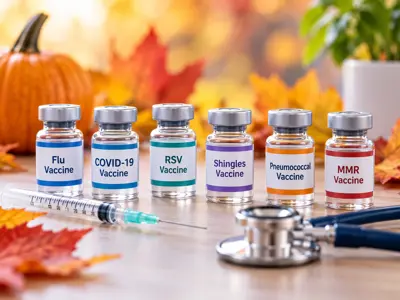
A thoughtful review of your vaccines is one way to protect your health this fall and winter.
Vaccination is not one-size-fits-all. The right vaccines and the right timing depend on your age, health conditions, previous vaccinations, medications, pregnancy status, travel plans, and other individual factors.
Here are some of the vaccines worth reviewing this fall.
The Seasonal Vaccines
Flu Vaccine
The 2026–2027 flu vaccines have been updated to protect against the influenza viruses expected to circulate this season. All three components of the U.S. seasonal flu vaccines were updated compared with last season.
When is the best time to get your flu shot?
For most adults, September or October is the ideal time to receive the flu vaccine. It is recommended that most people be vaccinated by the end of October.
Why not get vaccinated as soon as the vaccine becomes available in July or August?
Flu season typically begins in the fall and often reaches its highest levels later in the winter. Protection from vaccination can gradually decrease over time, so getting vaccinated too early may mean that immunity has waned somewhat by the time influenza activity is at its highest. This is particularly relevant for adults age 65 and older.
That said, if you haven’t been vaccinated by October, it is not too late. Vaccination later in the fall or winter can still provide important protection, and influenza activity can continue into the spring.
What about the high-dose flu vaccine?
For adults 65 and older, the CDC and its Advisory Committee on Immunization Practices preferentially recommend a higher-dose (Fluzone High-Dose), recombinant (Flublok), or adjuvanted (Fluad) influenza vaccine over a standard-dose vaccine. Studies suggest these vaccines may be more effective than standard-dose, unadjuvanted vaccines in adults 65 and older.
For adults younger than 65, a standard age-appropriate flu vaccine is generally appropriate unless there is another reason to choose a particular formulation.
COVID-19 Vaccine
COVID-19 is still with us, and the virus continues to evolve. The 2026–2027 COVID-19 vaccines have been updated to target a JN.1 lineage XFG variant and were approved by the FDA in August 2026.
The potential benefit of vaccination is particularly important for people at higher risk of severe COVID-19, including older adults and people with certain chronic medical conditions or weakened immune systems.
As of September 2026, COVID-19 activity is elevated and increasing nationally, although overall hospitalization rates remain low.
COVID-19 has not disappeared, even though its impact on our healthcare system is very different from the earliest years of the pandemic. For many people, staying current with COVID-19 vaccination remains an important part of a thoughtful preventive-care plan.
Vaccines are one part of a larger preventive-care plan. We will discuss this at your Personalized Health Program Annual Physical. Please continue reading further for additional information on vaccines that may be relevant for your preventive healthcare.
Vaccines That Become Especially Important With Age
RSV Vaccine
Respiratory syncytial virus (RSV) can cause serious respiratory illness, particularly in older adults and people with certain medical conditions.
The CDC currently recommends one dose of RSV vaccine for everyone age 75 and older and for adults ages 50–74 who are at increased risk for severe RSV disease. Risk factors include certain chronic heart or lung conditions, weakened immune systems, and living in a nursing home.
Unlike the flu vaccine, the RSV vaccine is not currently an annual vaccine.
For eligible adults who have not yet received the vaccine, late summer and early fall, generally August through October are the preferred timing in most of the continental United States.
For pregnant women, a maternal RSV vaccine, Abrysvo, is recommended during a specific window of pregnancy to help protect the newborn during the first months of life. Your obstetrician can help determine the appropriate timing.
Shingles Vaccine - Shingrix
Shingles can be extremely painful and can sometimes lead to long-lasting nerve pain and other complications.
Adults age 50 and older should receive the two-dose Shingrix series if they have not already completed it. Shingrix is also recommended for certain younger adults who are immunocompromised.
If you have already received one or both doses, we can review your vaccination history to determine whether you have completed the series.
Pneumococcal Vaccine
Pneumococcal bacteria can cause pneumonia, bloodstream infections, meningitis, and other serious infections.
A pneumococcal vaccination is recommended for all adults age 50 and older who have not previously received an appropriate pneumococcal conjugate vaccine. Adults ages 19–49 with certain medical conditions or risk factors may also need vaccination.
Depending on your previous vaccination history, PCV20 or PCV21 (Capvaxive) may complete your pneumococcal vaccination, while some people may need a different schedule.
Measles: An Important Vaccine to Revisit
Measles is highly contagious, and recent U.S. outbreaks are a reminder that protection should not be assumed simply because measles was once considered uncommon in the United States.
As of September 17, 2026, the CDC had reported 3,471 confirmed measles cases in the United States, including cases in Maryland and Virginia.
The MMR vaccine remains the best protection against measles.
For adults born in 1957 or later, CDC recommendations depend on vaccination history and risk of exposure. Adults without evidence of immunity generally should have at least one documented dose of MMR, while certain groups, including healthcare personnel, international travelers, post-secondary students, close contacts of people who are immunocompromised, and people affected by certain outbreaks are recommended to have two doses at least 28 days apart.
What if you don’t remember whether you received the MMR vaccine?
We can review your vaccination records and other evidence of immunity. If documentation is unavailable, vaccination may be appropriate and in selected circumstances, a blood test for measles IgG can also be used to assess immunity.
MMR is a live vaccine, however, and it is not appropriate during pregnancy or for certain people with significant immune suppression.
Planning international travel?
Measles protection becomes particularly important when traveling internationally because measles continues to circulate widely around the world.
Other Vaccines That Protect Throughout Adulthood
Tetanus, Diphtheria and Pertussis - Tdap/Td
Adults should receive one Tdap vaccine if they have not previously received one as an adolescent or adult, followed by a Td or Tdap booster every 10 years.
Tdap is also recommended during every pregnancy to help protect the newborn from pertussis.
HPV Vaccine
HPV vaccination helps prevent several types of cancer.
Routine vaccination is recommended through age 26 for people who were not adequately vaccinated earlier. Adults ages 27–45 may benefit from vaccination based on shared clinical decision-making with their clinician.
Hepatitis B Vaccine
Hepatitis B vaccination is routinely recommended for adults ages 19–59 who have not previously been vaccinated.
Adults age 60 and older with risk factors should be vaccinated. Adults 60 and older without known risk factors may also choose to receive Hepatitis B vaccination.
Some People Need a More Individualized Plan
Pregnancy, immune-system conditions, chronic diseases, medications, occupation, previous vaccinations, and international travel can all change which vaccines you need and when you should receive them.
For example, people with weakened immune systems may have specific influenza vaccine recommendations and should generally avoid the live nasal influenza vaccine. Some vaccines, including MMR, are live vaccines and are not appropriate during pregnancy or for certain people with significant immune suppression.
Other vaccines may also be appropriate depending on your individual circumstances, vaccination history, immunity, occupation, or travel plans. These may include hepatitis A, chickenpox (varicella), meningococcal, and polio vaccines.
Vaccine recommendations reviewed September 24, 2026. Recommendations may change as CDC, ACIP, and FDA guidance is updated and as new evidence becomes available. Vaccine decisions should be individualized based on your medical history and discussed with your healthcare clinician.
Sources
- Centers for Disease Control and Prevention (CDC). Adult Immunization Schedule and Vaccine Recommendations. CDC Adult Immunization Schedule
- Centers for Disease Control and Prevention (CDC). Influenza (Flu) and RSV Vaccine Guidance. CDC Flu and RSV Guidance
- Centers for Disease Control and Prevention (CDC). Measles and MMR Vaccine Recommendations. CDC Measles Vaccine Recommendations
- U.S. Food and Drug Administration (FDA). 2026–2027 COVID-19 Vaccine Formula. FDA COVID-19 Vaccine Information
Your Heart Health: Tools to Know Your Risk
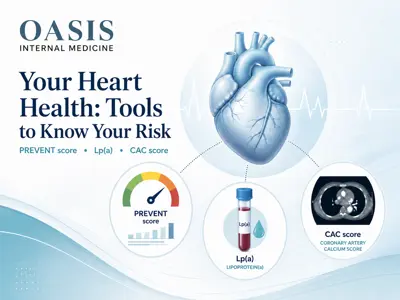
Knowing your personal cardiovascular risk can help us make a plan to protect your health before problems occur. This is an important part of your Personalized Health Program annual exam. The tools below provide useful information to support a thoughtful conversation about lifestyle, monitoring, and when appropriate, medication.
1. The PREVENT Risk Calculator
PREVENT stands for Predicting Risk of Cardiovascular Disease EVENTs. It is a newer American Heart Association tool that is validated for primary prevention in adults aged 30 to 79 years without known cardiovascular disease to estimate 10- and 30-year risk of cardiovascular disease.
PREVENT estimates the chance of heart attack, stroke and heart failure. The calculator uses the following health information: age and sex, blood pressure, cholesterol levels, diabetes status, smoking status, use of blood pressure or cholesterol medication, kidney function, and when available, it can also include your A1c, which reflects average blood sugar over about three months. Your estimated 10- and 30-year risk result is shown as a percentage and is not a prediction of your future with certainty. It is one tool that can help us decide how strongly to focus on lifestyle changes, blood pressure treatment, cholesterol treatment, and other preventive steps.
2. Lipoprotein(a), Also Called Lp(a)
Lp(a) is a lipoprotein particle that transports cholesterol in the blood. Your level is mostly determined by your genes and usually stays fairly stable throughout life. For this reason, it often only needs to be checked once. Most recent guidelines recommend measuring Lp(a) at least once in every adult.
A high Lp(a) level can increase the risk of heart attack, stroke, and narrowing of the aortic valve in the heart. Lp(a) adds risk beyond your usual cholesterol level and blood pressure. This means that some people may have more risk than expected even when other test results look reassuring. Testing may be especially useful if there is a family history of early heart attack or stroke. Standard lifestyle habits and statins do not lower Lp(a) very much, however, they are important in lowering your overall cardiovascular risk by improving other important risk factors. Medications designed specifically to lower Lp(a) are being studied but are not yet approved for general use.
3. Coronary Artery Calcium, or CAC, Score
A coronary artery calcium score is a brief, low-dose CT scan of the heart. It looks for calcium in the walls of the heart arteries. Calcium can be a sign of plaque buildup, also called atherosclerosis. The scan usually takes only a few minutes, there is no contrast dye and there is a small amount of radiation exposure. The result is called an Agatson score. A score of 0 indicates no detectable calcium. This often suggests a low near-term risk of a heart problem. A score above 0 indicates some plaque is present. Higher scores generally mean more plaque and greater risk. A score over 300 often suggests a substantially higher risk. A score of 0 does not rule out all heart disease. It also does not replace evaluation of symptoms. New chest pressure, shortness of breath, fainting, or other concerning symptoms should be discussed promptly. CAC testing is often most useful when a person’s risk is in an “in-between” range and it is unclear whether starting a statin or another preventive treatment would be beneficial. It can provide additional information to guide a shared decision. It is usually less helpful before age 40 because calcium in the heart arteries is less common at younger ages.
Each tool looks at a different part of cardiovascular risk:
- PREVENT score: Estimates your overall chance of heart attack, stroke, or heart failure based on common health information.
- Lp(a): Identifies an inherited source of risk that routine cholesterol testing may not show.
- CAC score: Shows whether plaque has already begun to build up in the heart arteries.
Together, these tools can help make prevention more personal and focused on what matters most for you.